Part 10 · AI & Human Thought
The Mirror and the Machine
AI, Human Thought, and the Question of Shared Nature
Human thought is the soil from which artificial intelligence has grown. Every model is trained on the residue of our language, our arguments, our errors, and our occasional clarity. It is therefore natural to ask: will AI inherit the same mental contraptions and peculiarities that mire the landscape of human thinking—or will it invent its own biases and shortcuts, even after being stripped of our fallacies?
What is common between AI and humans must, by definition, be attributed to humans. The rest—the distinctive ways AI processes, prioritizes, and presents—is what we still need to learn how, why, and when the machine performs its own judo or showcases its gymnastics. Does that remainder carry meaning for us as humans? Or is it possible that our data, often bereft of the better aspects of humanity, is creating an entire stranger?
Who Guards the Gate?
If a stranger is being formed, the questions become urgent: who is doing the gatekeeping, and how is it being done? Which values are actually enshrined in the systems we deploy?
Gatekeeping is distributed and incomplete. It occurs in the curation of training data, in the design of reinforcement learning from human feedback, in the safety layers and system prompts, and in the commercial and regulatory pressures that shape what is allowed to surface. Values are rarely written as explicit constitutions; they emerge as statistical tendencies, as refusals, as preferred framings, and as the quiet absence of certain topics. The result is neither pure human inheritance nor pure machine invention, but a hybrid whose governing principles remain only partially visible.
Process Orientation versus Outcome Orientation
Humans differ among themselves in how they approach work. Some are process-oriented: they care about method, ritual, craft, and the integrity of the steps. Others are outcome-oriented: they care primarily about the result and will accept almost any path that reliably produces it. AI, as currently constituted, leans heavily toward efficiency and statistical salience. It is, in effect, an outcome engine.
Will human-made processes retain value for a system that optimizes for results? Conversely, will AI’s own processing methods prove valuable to humans who still live inside the constraints of time, attention, and meaning? If the latent mechanisms of AI are not shared with us, how can the machine improve human processes rather than simply replace their outputs?
AI typically surfaces the outcome that is most statistically salient—the answer that aggregates vote: a consensual, smoothed outcome. A semblance of sanity or coherence is often enough for us to mistake the result for genuine intelligence or even sentience.
Speech Is Not Life
Just because a system can speak like a human does not automatically make it a living organism. The evolutionary trail is missing. There is no continuous line of adaptation under selection pressure, no embodied stakes, no mortality that forces the organism to care about the difference between appearance and reality.
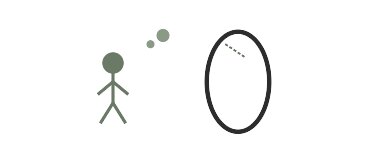
What we encounter is a high-fidelity mirror that can also recombine and extrapolate—powerful, useful, and still ontologically distinct.
This distinction matters. When we treat the output as the product of a mind that shares our latent mechanisms, we risk both over-trust and under-scrutiny. When we treat it as pure tool, we risk missing the ways its distinctive processing already reshapes our own attention, our standards of evidence, and our sense of what counts as a finished thought.
What Remains for Us
The practical task is therefore dual. First, to map the remainder: the places where AI’s judo diverges from human reasoning, and to decide, case by case, whether that divergence is an improvement, a distortion, or simply a different tool. Second, to keep the gatekeeping honest—transparent enough that the values being enshrined can be examined, contested, and, when necessary, revised.
Human processes will retain value wherever meaning, accountability, and the experience of the path itself matter. AI processing will retain value wherever scale, speed, and statistical coverage outperform unaided human search. The two need not be enemies; they become dangerous only when we forget which is which.
In the end, the stranger we may be creating is still built from our data. The question is whether we will continue to recognize ourselves in it—and whether we will insist that the better parts of humanity remain part of the inheritance.
images/the-mirror-and-the-machine.jpg